
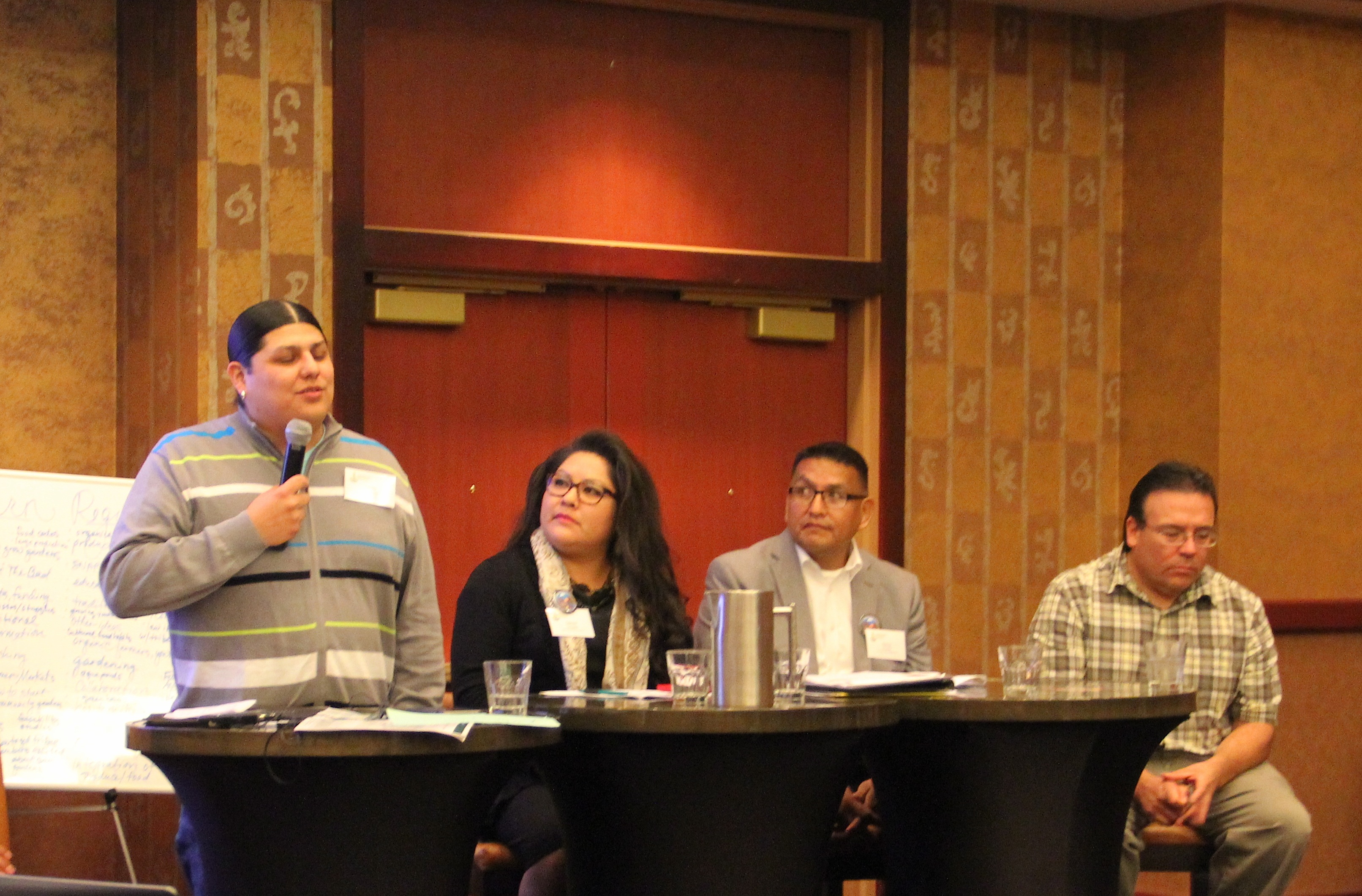
Afternoon panel “Pushing the Envelope: Changing the landscape with Law and Policy.”
Leotis McCormack, from the Columbia River Inter-Tribal Fish Commission Commissioner and Nez Perce Tribal Executive Committee Member spoke about the struggle to translate cultural issues into policy, and quantifying tribal interests as ecosystem based functions. The Inter-Tribal Fish Commission fought dams along the Columbia River that blocked access to fish. To his left, Denisa Livingston from Dine Community Advocacy Alliance and Danny Simpson, former Navajo Nation Council Delegate, presented about the process behind passing the Navajo Junk Food Tax. Denisa described how there are currently 25,000 Navajos with diabetes, and 75,000 who are pre-diabetic. For Navajo Nation, $325 million is spent per year for the basic treatment of diabetes and $2.5 billion is spent on the treatment of diabetes related complications. In an effort to curb some of these costs and suffering, the Dine Community Advocacy Alliance decided to target the types of foods that their fellow community members were consuming, and crafted the Healthy Dine Nation Act of 2014. The Navajo Nation charges 5% sales tax on all food. This tribal legislation eliminates that tax on healthy foods like fresh fruits and vegetables, nuts and nut butters, hominy, beans, and bottled water water. In addition, an extra 2% tax was added to junk foods like soda and chips (for a total of 7% tax on these foods, and 0% tax on healthy foods.) The tax collected will go into Community Wellness Development Projects, like gardens, farmers markets, healthy recreation programs, and educational materials about which foods are taxable and non-taxable. According to Danny, the Navajo Nation president, under pressure from lobbyists from beverage companies initially vetoed the Act, but it signed when he was presented with it a second time, and the Healthy Dine Nation Act (known informally a the Navajo Nation Junk Food Tax) was officially passed in the summer of 2014.
Mike Wiggins (to the far left on the panel), who was at the time the Chairman of the Bad River Band of Lake Superior Chippewa, presented about his community’s efforts to fight mining and protect their water. The Tribe fought to establish a 70 mile radius around the reservation in which they would need to be at the table to consult and comment if extractive industries attempt to move into this area. Thus far they have fought an open pit taconite mine, as well as a 26,000 pig CAFO that would have contaminated their watershed. He highlighted that Ojibway people are “food producing dynamos,” and in order for that to continue to be possible, the Tribe needed to fight to maintain the health of the environment they were ensured access to in their treaties.
 From Garden Warriors to Good Seeds: Indigenizing the Local Food Movement
Leave a comment